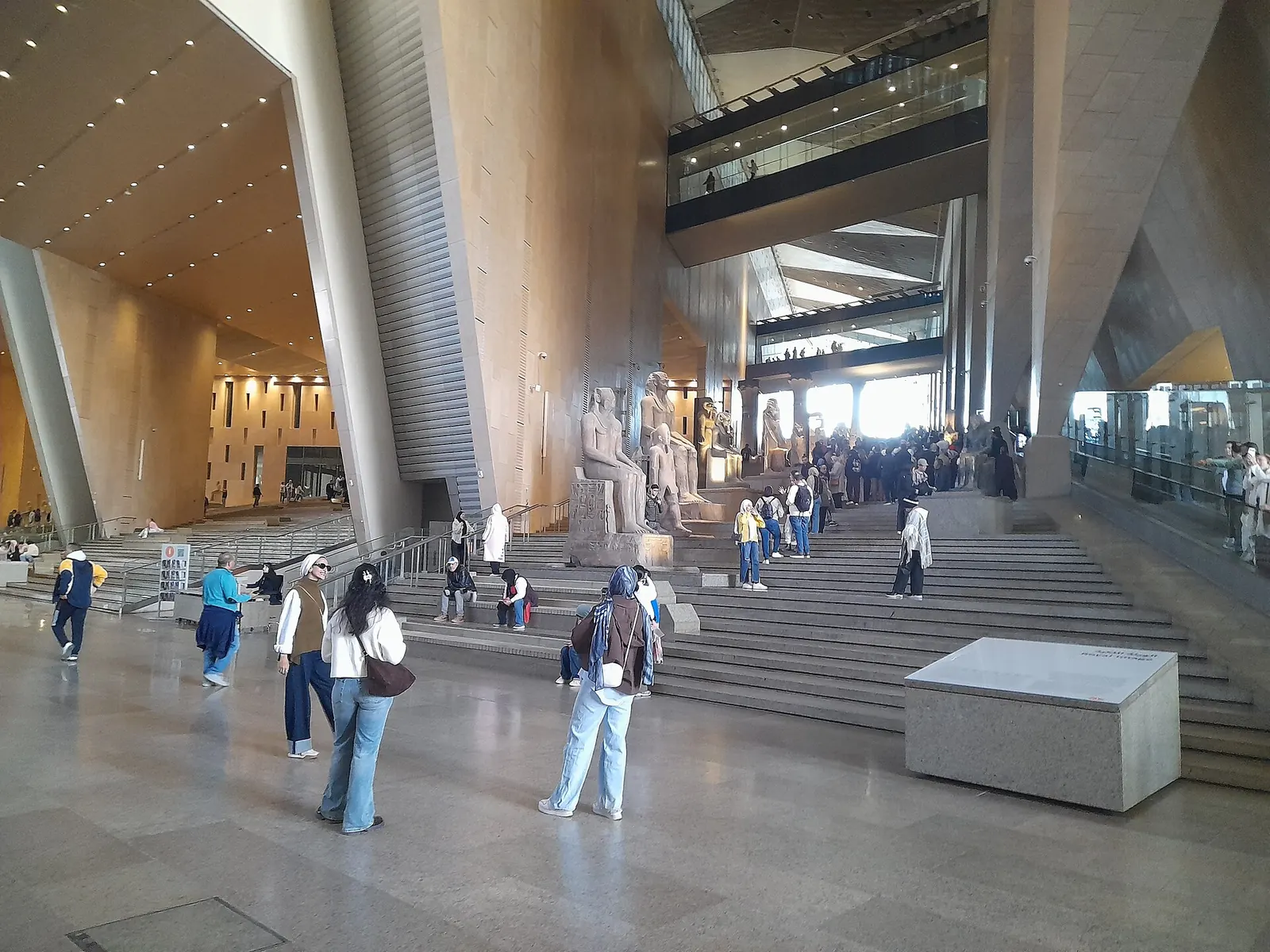
The Grand Egyptian Museum was conceived to address collection scale, conservation and the relationship between a national antiquities museum and the Giza pyramids. Its history spans site allocation, international competition, financing, construction, object transfer and staged access.
1992–2003 · SITE AND DESIGN
The project began as an urban and landscape decision.
Land near the Giza plateau was allocated for a new museum in 1992. The location placed the institution outside central Cairo and within visual reach of the pyramids, creating both an architectural opportunity and a major transport challenge.
A foundation stone was laid in 2002, and an international architectural competition drew an unusually large field. In 2003, the Dublin-based practice Heneghan Peng won with a design organized by long perspective lines, a translucent stone-like façade and a level change between the Nile valley and desert plateau.
2005–2010 · CONSERVATION FIRST
The museum was also a working infrastructure.
Site preparation and construction advanced in phases through complex contracting and financing. The Conservation Center became operational before the main galleries, allowing specialists to receive, document and treat objects intended for transfer.
This sequence matters. A museum move is not simply transport from one display case to another. It requires condition assessment, packing, environmental planning, photography, database work and sometimes lengthy stabilization. Conservation became one of the project’s earliest functioning public-interest roles even while the main building remained unfinished.
2011–2020 · DELAY AND CONTINUITY
Political and technical time overlapped.
The years after 2011 brought political upheaval and economic pressure, while engineering, fit-out and collection preparation continued unevenly. Announced opening targets moved more than once. Such delays are not explained by a single cause: project scale, funding arrangements, infrastructure, security, gallery design and external crises all affected the timetable.
High-profile transfers—including monumental sculpture and objects associated with Tutankhamun—made progress publicly visible. They also shifted the histories of older institutions, especially the Egyptian Museum in Tahrir, whose identity had long been tied to those collections.
2020s · ACCESS IN PHASES
Opening became a process.
The pandemic added further disruption. Later, limited areas, events and trial operations introduced visitors to parts of the complex before the full museum program was available. Expanded public access in 2024 and the culminating opening phase in 2025 belong to this staged history rather than to a single instant when the project suddenly became complete.
- 1992 Giza site allocated.
- 2002 Foundation stone and competition launch period.
- 2003 Heneghan Peng design selected.
- 2010 Conservation Center operating.
- 2024 Expanded trial access to major spaces and galleries.
- 2025 Culminating public opening phase.
The institution will continue changing after opening. Collection moves, conservation findings, visitor circulation and revised interpretation are part of museum history, not evidence that history has ended.
Source note
This account uses project material from the museum, the design competition record, architectural documentation and institutional announcements. Opening terminology varied across years; “trial,” “partial,” “soft” and “official” access should not be treated as interchangeable.