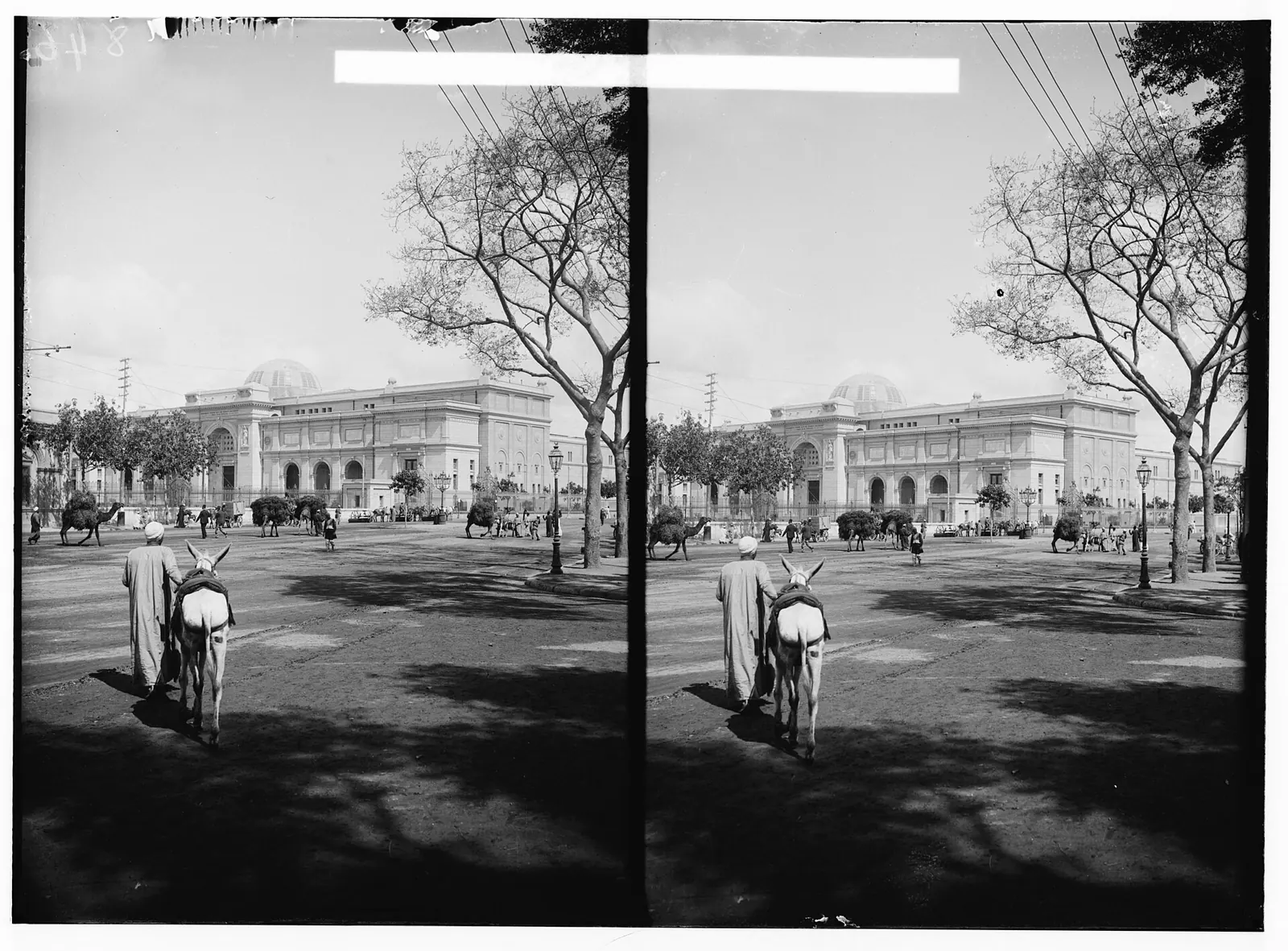
To understand the Egyptian Museum in Tahrir, follow the collections before following the building. Flood risk, storage pressure, colonial administration and a growing archaeology all shaped where objects were kept and how they were shown.
1835–1858 · BEFORE BOULAQ
A collection needed an institution.
Muhammad Ali issued an antiquities ordinance in 1835 and a collection was assembled in Cairo, but early preservation efforts were unstable. The decisive administrative step came with the creation of the Egyptian Antiquities Service in 1858 under Auguste Mariette. Its riverfront premises at Boulaq combined offices, storage and public display.
Boulaq is often called the first Egyptian antiquities museum, but “first” can hide earlier collection efforts and the unequal power structures of nineteenth-century archaeology. The institution formed within an Egyptian state while senior archaeological administration and much scholarship were strongly shaped by Europeans.
- 1835 Antiquities ordinance and early Cairo collection.
- 1858 Antiquities Service established; Mariette becomes its first director.
- 1863 Boulaq museum opens to the public.
1878–1891 · WATER AND MOVEMENT
The Nile exposed the limits of Boulaq.
A severe flood in 1878 damaged the Boulaq premises and records. The collection remained vulnerable and increasingly crowded. In 1891 it moved to a former khedivial palace at Giza. That setting offered more room but was an adaptation, not a building designed for conservation and public circulation.
The sequence matters: the Tahrir museum did not replace an empty field. It inherited objects, cataloguing problems, display habits and institutional ambitions accumulated at Boulaq and Giza.
1895–1902 · A PURPOSE-BUILT MUSEUM
Architecture became an argument about order.
An international competition led to the selection of French architect Marcel Dourgnon’s design. Construction began in 1897, and the museum was officially inaugurated in 1902. Its symmetrical plan, central atrium, long galleries and overhead light offered a new framework for a rapidly expanding collection.
The building joined a developing administrative quarter near what later became known as Tahrir Square. Over time, the museum’s pink façade became a civic landmark even as traffic, political events and new construction repeatedly changed its urban setting.
TWENTIETH CENTURY → PRESENT
A historic display is never frozen.
Excavations continued to add material, most famously after the discovery of Tutankhamun’s tomb in 1922. Galleries, cases, storerooms and conservation practices changed. In the twenty-first century, major transfers to the National Museum of Egyptian Civilization and the Grand Egyptian Museum altered expectations about what belongs in Tahrir.
Those moves do not make the older museum merely a leftover. They make its future a curatorial question: how should a landmark building interpret the history of archaeology, collection and display while continuing to present ancient material? The answer is still being written through renovation, research and gallery decisions.
Source note
This chronology draws on institutional histories of the Egyptian Museum and Antiquities Service, architectural records, and scholarship on nineteenth-century Egyptian archaeology. Dates describe documented institutional events; interpretations of colonial power and urban meaning require multiple scholarly perspectives.