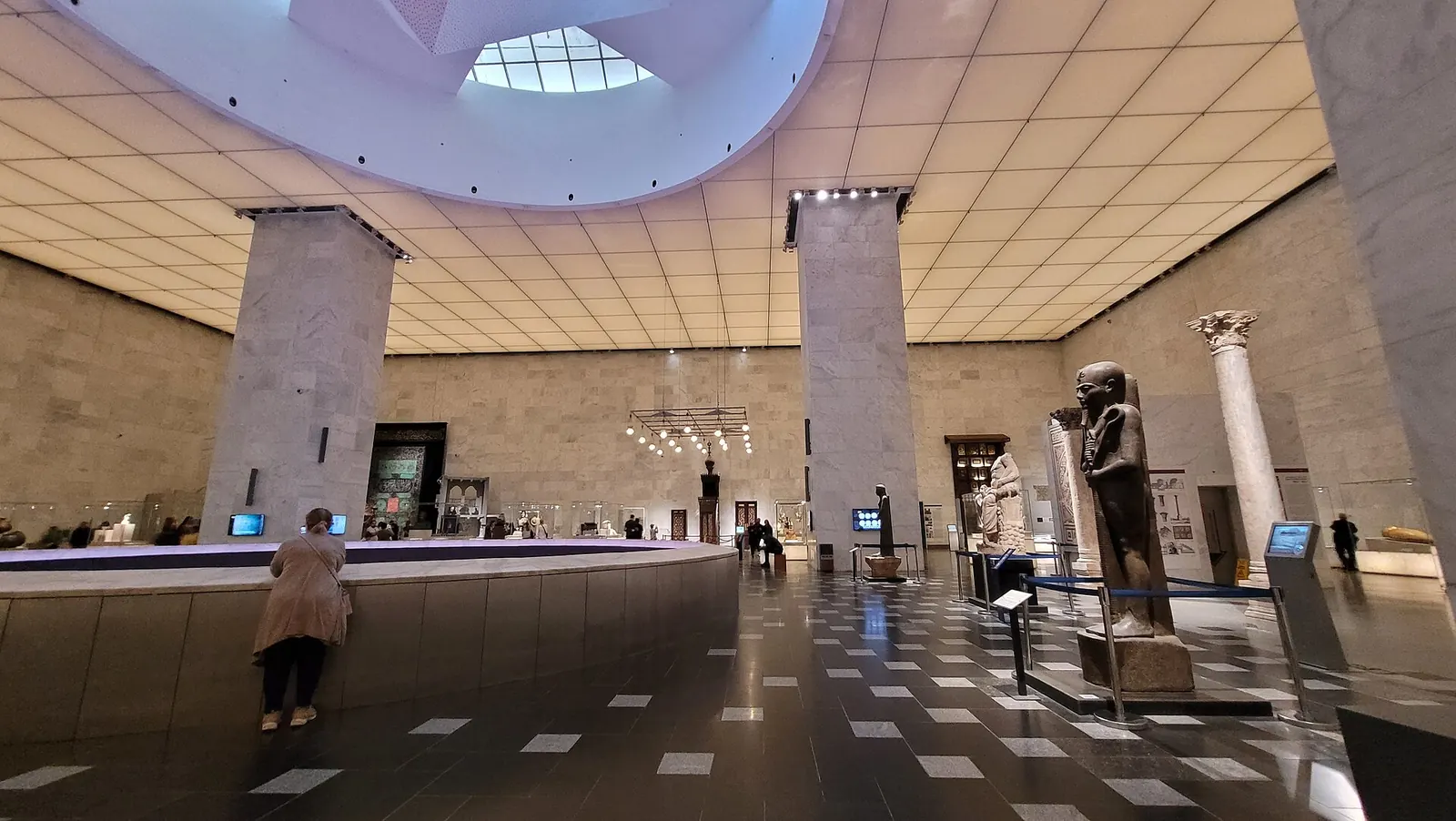
The National Museum of Egyptian Civilization is often remembered through its 2021 opening spectacle, but its institutional history is much longer. Its central question—how to narrate civilization across many periods—developed through decades of planning.
A CONCEPT, NOT ONLY A BUILDING
Egyptian history needed a different frame.
Most archaeology museums organize material by period, dynasty or site. The civilization-museum concept proposed a broader account that could include work, writing, belief, craft and everyday life across prehistoric, ancient, Coptic, Islamic, modern and contemporary Egypt.
UNESCO worked with Egyptian authorities on the project from the 1980s. Long development meant that the museum’s concept passed through changing political, professional and financial conditions. A founding idea, a completed building and an open permanent display therefore belong to different dates.
FUSTAT AND AIN AL-SIRA
The selected site added its own chronology.
The museum was built at Fustat, near Ain Al-Sira, in an area important to the early Islamic history of Cairo and shaped by later urban and environmental change. The setting connected the new national institution to a historic landscape outside the familiar museum cluster of central Cairo and Giza.
Archaeological work accompanied development, and the project combined museum construction with wider changes to the surrounding area. The location is not simply a backdrop: it influences which periods of Cairo’s history become visible around the museum.
2017–2021 · OPENING IN STAGES
Public access arrived before the full narrative.
A temporary exhibition on Egyptian crafts opened in 2017, giving the public access to part of the institution before completion of the main displays. The major public turning point came in April 2021, when a nationally broadcast procession transferred royal mummies from the Egyptian Museum in Tahrir to Fustat.
The event linked two museum histories through movement: bodies collected and displayed under one institutional order entered another, with a specially designed hall and a different interpretive atmosphere.
- 1980s UNESCO-supported planning develops the museum concept.
- 2000s Construction and site development advance at Fustat.
- 2017 Temporary crafts exhibition opens.
- 2021 Main public opening and transfer of royal mummies.
THE POLITICS OF A LONG STORY
Continuity is created through selection.
A thematic civilization museum can connect technologies and practices across time, countering the isolation of periods into separate specialist worlds. It can also make “continuity” appear smoother than historical evidence allows. Conquest, language change, religious plurality, regional difference and social inequality do not always fit a unified national arc.
NMEC’s historical significance lies in making this problem public. It is not just a new home for transferred objects; it is an institutional argument about the scale and duration of Egyptian history.
Source note
Dates are drawn from NMEC and UNESCO project histories and records of the 2017 and 2021 openings. Because long projects often publish retrospective timelines differently, we distinguish proposal, construction, partial access and major opening.