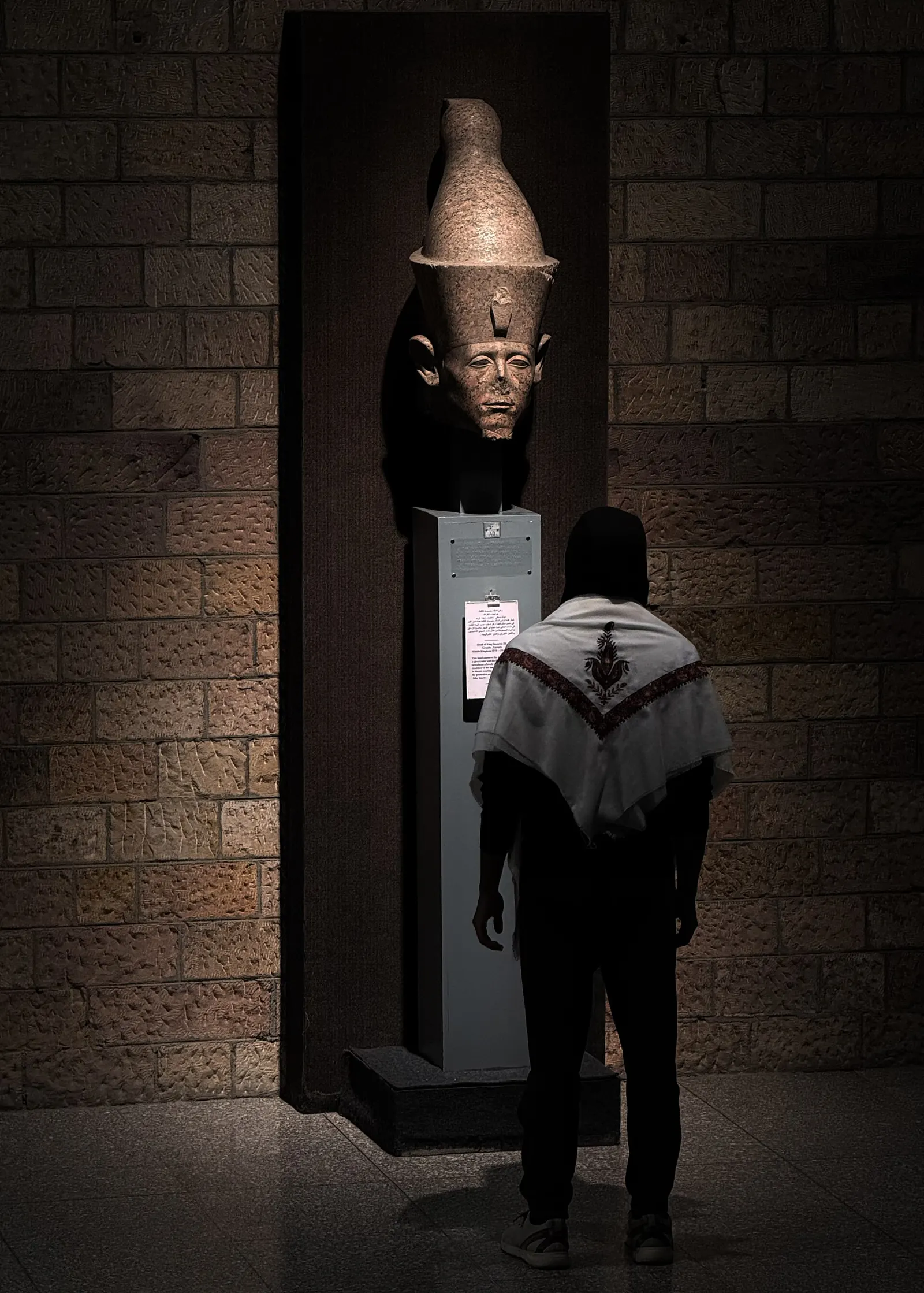
Luxor already contained temples, tombs and active excavations. Its new museum did not try to reproduce an encyclopedic national collection. It made selectivity—and a close relationship to ancient Thebes—its identity.
THE REGIONAL QUESTION
Why build a museum beside the sites?
Objects excavated in the Theban region had long travelled to Cairo and collections abroad. A museum in Luxor could retain and interpret material closer to its archaeological geography while giving visitors a controlled setting different from open-air monuments.
Egypt began the project in the 1960s, and the museum opened in 1975 on the Corniche between the Luxor and Karnak temple areas. Its position connected modern riverfront circulation with the monumental landscape without claiming to be an ancient setting.
1975 · A CURATED OPENING
Fewer objects could carry more context.
Compared with the dense historic galleries in Cairo, Luxor Museum became known for restraint: generous spacing, controlled lighting and a selection strongly tied to Theban history. The approach reflected wider twentieth-century museum design, in which isolated presentation could encourage formal appreciation and clearer interpretation.
Selectivity is never neutral. Choosing a smaller number of “high-quality” works can clarify a story, but it can also privilege royal art, exceptional craftsmanship and visually complete objects over ordinary, fragmentary or poorly provenanced material.
COLLECTIONS THAT CHANGED THE MUSEUM
Local discoveries repeatedly revised the display.
The museum’s identity developed after opening. Material associated with Theban excavation and conservation entered new galleries. The cache of statues found during work at Luxor Temple in 1989 created a major opportunity to present a documented group close to its findspot. Later expansion added space and new interpretive sequences.
These additions show why a museum’s “opening” is not its final form. A regional institution can respond to discoveries in its surrounding archaeological landscape more directly than a fixed national survey.
THE LEGACY OF RESTRAINT
Atmosphere became part of authority.
Visitors often describe Luxor Museum through calm, lighting and visual clarity. Those qualities influence trust: a spacious object can appear more coherent and important than the same object in a crowded case. Design produces historical meaning alongside labels.
The museum’s legacy is therefore double. It strengthened local archaeological context, and it demonstrated how powerful a selective display can be. A critical history appreciates that achievement while continuing to ask who selected, by which criteria, and how those criteria changed.
Source note
The 1975 opening date and 1989 Luxor Temple cache are stable chronological anchors. Precise gallery phases and object moves should be checked against excavation publications, catalogues and current institutional records.